

Introduction
Polytomic Harbors: secure data and context stores for your AI agents
About
Polytomic Harbors are fast and secure data and context stores to enable your AI agents to quickly and securely query data from anywhere. You can spin them up and down on demand.
Each Harbor consists of three components, all provided by Polytomic:
- A storage container designed for fast queries (typically this will be Polytomic-managed storage, though it can also be your data warehouse or other database).
- Syncs that feed it with tables and fields of your choosing (these can come from anywhere: your data warehouse, production databases, CRMs, spreadsheets, marketing and finance apps, etc). The syncs can handle large datasets.
- Context documents that describe the datasets in the Harbor and any business logic specific to your data.
Once a Harbor is active, AI agents can connect to it through MCP and query the data in natural language. Because of the context documents in Step 3, all connecting agents become automatically aware of how to query the data with accuracy.
Connecting agents
Polytomic Harbors are neutral about the actual agent used to query them. Because they each come with an MCP server, you can use any agent that supports MCP to query your Harbors: Claude, ChatGPT, Notion Agents, and others.
Benefits
The typical approach to providing AI agents with query ability is to give them access to the data warehouse and/or vendor MCP servers. However, especially since most of agent use comes from those outside the data team, there are risks that Harbor mitigates:
1. Joining data across MCP servers is often expensive and impractical
MCP servers are designed for single-provider use. Joining data across multiple systems (e.g. Salesforce, Gong, HubSpot, Snowflake, etc) is often going to fail due to rate-limit exhaustion. In addition, it's a slow operation and expensive token-wise.
It's much faster and cheaper to index the data in Harbor first then query that.
2. Giving an agent access to the whole data warehouse is unsafe
Those outside the data team typically do not need access to all tables in the warehouse. A marketing person may only need three tables from Salesforce and HubSpot. A finance person may only need to query two tables in NetSuite, a Google Sheet, and a table in the data warehouse.
Giving these agents access to the whole data warehouse risks sensitive data being unnecessarily surfaced in response to agent queries.
Harbors, on the other hand, are kept in sync with exactly the source tables and fields specified and no more. Security is solved by physical isolation: it is impossible for an agent to see data outside the Harbor it has access to.
3. Context documents result in accurate query responses
Once you attach context documents (think of them as agent skills specific to the Harbor) to your Harbor, every connecting agent will be automatically aware of them. And because each Harbor's data is curated, unlike with data warehouses there is no risk of your agent being misled by stale and expired tables that should be ignored.
These facts combine to result in fast and accurate responses to agent queries.
4. Per-Harbor user access management
Besides the physical separation of data granted by Harbors, each Harbor comes with its own user and agent-management controls. You have full control over which users' MCP connections have access to each Harbor.
(In the rare case where you do have per-user RBAC permissions set in your data warehouse for every agent access across your organization, Polytomic Harbor can use those permissions to your warehouse for querying rather than managing its own storage indexes.)
5. Harbor management supported through MCP and API
Polytomic has a first-class API for managing Harbors and their context documents (example API here: https://apidocs.polytomic.com/api-reference/harbors/create-context).
This means that, besides clicking in the admin console, you are also able to manage all Harbor provisioning, syncing, and context management through your agents (using the Polytomic MCP server) or through the API. This makes Harbors suitable data stores for customer-facing functionality, as multi-tenant isolation is supported by definition due to each Harbor being isolated from the rest.
Example
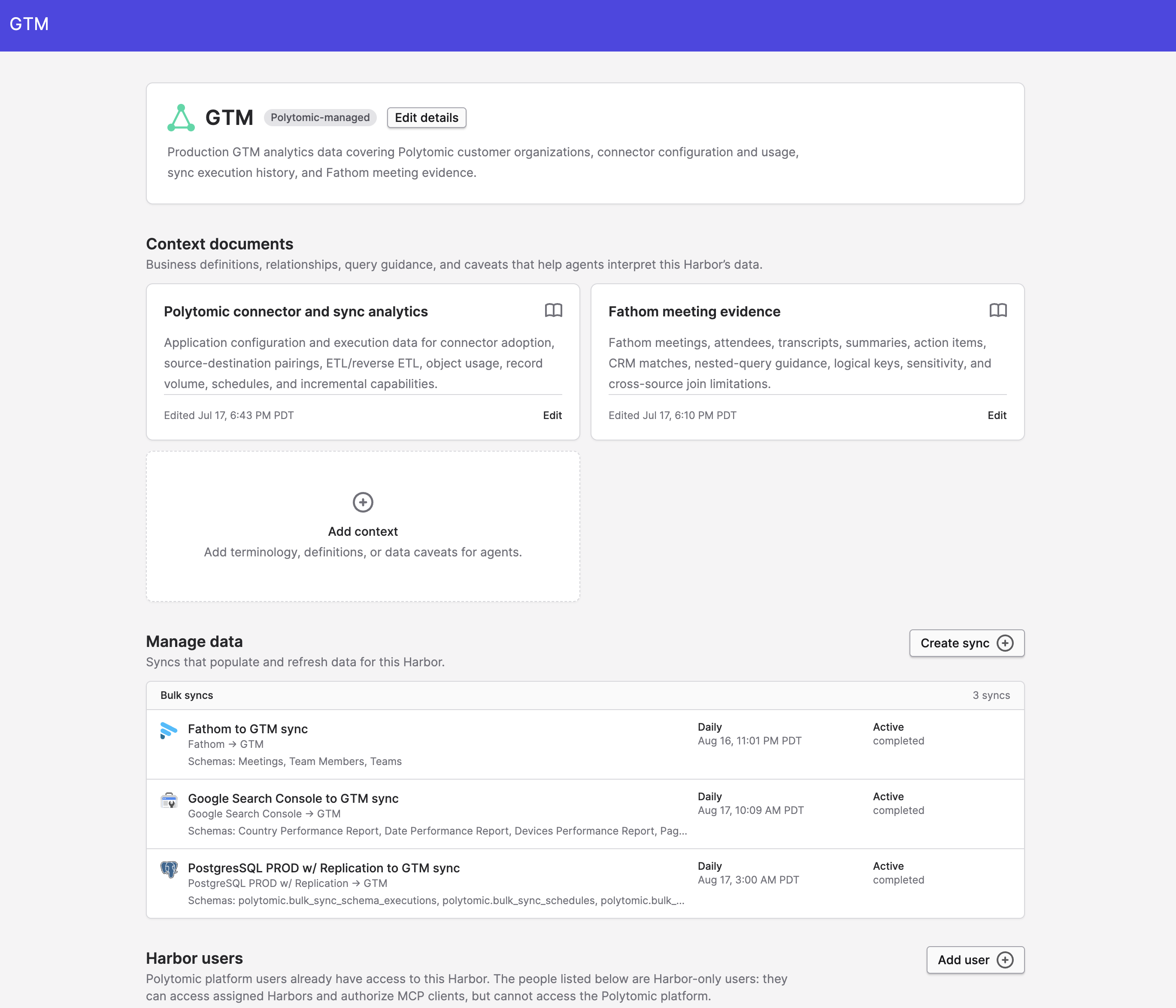
Here is an example Harbor containing the following:
- Call transcripts from Fathom (a popular call recorder).
- Product usage data from a PostgreSQL database.
- Google Search Console analytics.
- Context documents describing the above datasets.
Updated about 2 months ago