

SFTP
Source and destination
- In Polytomic, go to Connections → Add connection → SFTP.
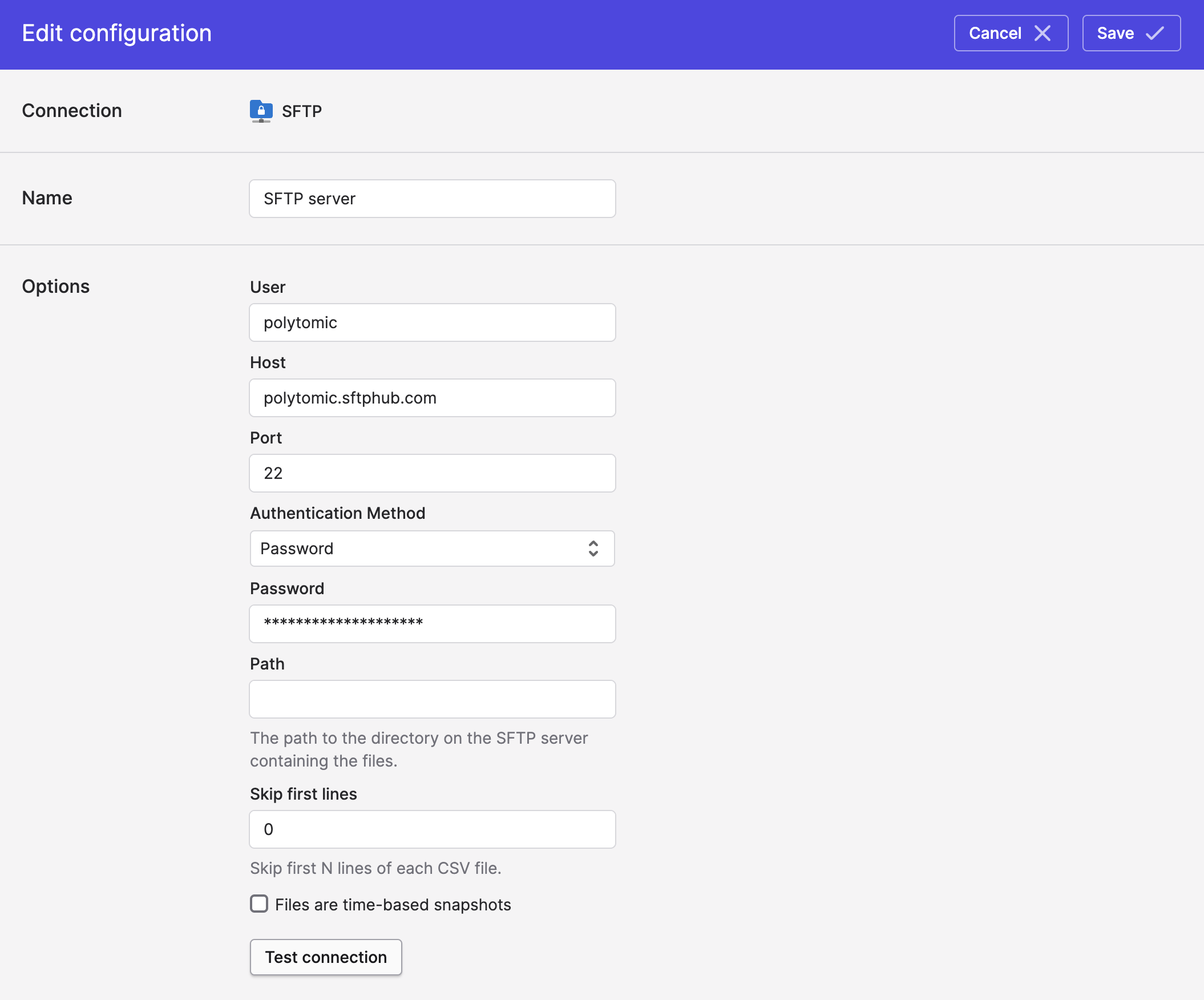
- Enter your server's Host, Port (default
22), and User. Then choose an Authentication method. Polytomic supports authenticating to SFTP using either a password or a private key:
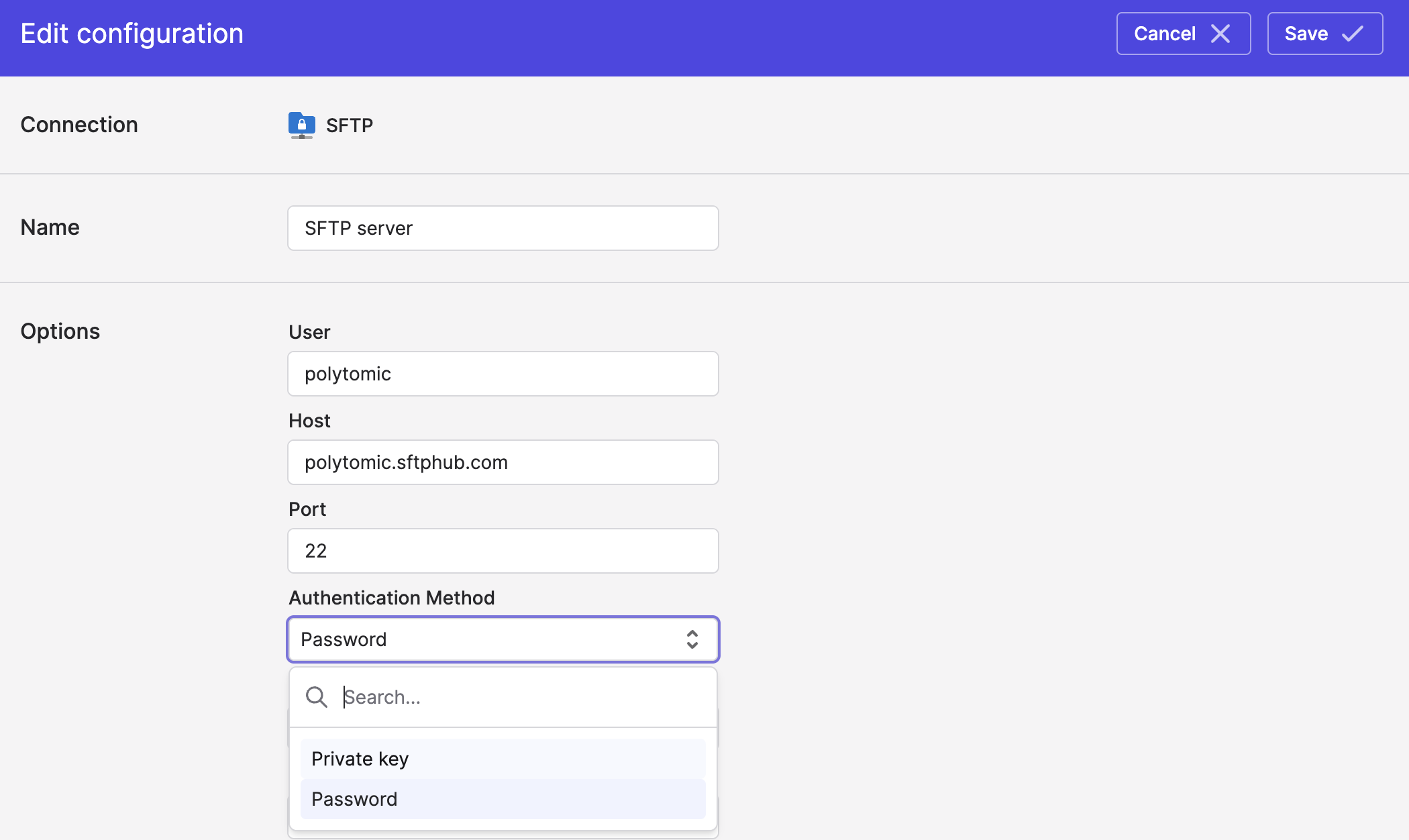
- Private key: upload the private key file for the user. The key must not be protected by a passphrase. We recommend generating a key pair just for Polytomic and adding its public key to the user's
~/.ssh/authorized_keyson the server. - Password: the user's password. Polytomic uses SSH password authentication. Servers that only allow keyboard-interactive authentication aren't supported.
- Enter the Path to the directory on the server containing your files.
- Click Save.
Network accessIf your SFTP server only accepts connections from known IP addresses, allow Polytomic's IP addresses.
Host key verificationPolytomic doesn't verify the server's host key.
Syncing from SFTP servers
Use Bulk Syncs to sync files from SFTP servers to your data warehouses, databases, and cloud storage buckets like S3. SFTP is supported as a source only.
Polytomic reads CSV files (.csv), which may be compressed with .gz, .bz2, or .zst. Polytomic ignores other files in the directory. If your CSV files have lines before the header row, use Skip first lines to skip them.
Concatenating source files
If you would like the files in your SFTP directory concatenated into one table in your destination (e.g. one table in your data warehouse), you should check the Files are time-based snapshots box. This is typically desired if you're (for example) dealing with daily archives of financial transactions. All files share the same format but their data is split.
Once you check that box, you will be asked to enter a Collection name. This will be the name of the output table containing your concatenated data once you activate a sync:

Updated about 17 hours ago